
Table of Contents
Today, change is constant. New material streams. Optical sorters. Automation upgrades. Throughput increases. Safety retrofits.
For operators, engineers, equipment manufacturers, and contractors, modernization is no longer occasional. It is continuous.
Many MRFs operating across North America were originally built in the 1990s. Since then, they have undergone dozens of small and major retrofits. Equipment has shifted. Structures have been modified. Systems have been automated.
What rarely evolved at the same pace was the documentation.
For owners and project teams, that gap introduces real risk. Complex upgrades are executed inside facilities that no longer match their drawings.
That is where uncertainty enters the process.
The Hidden Risk in Legacy Facilities
For years, major retrofit programs were planned using:
- Outdated existing condition drawings
- Overlayed 2D equipment layouts
- Manual field measurement
- Coordination through email and phone calls
Changes from prior upgrades were not consistently captured. Record drawings drifted from field reality. Each new retrofit layered additional complexity on top of incomplete information.
When assumptions about existing conditions were wrong, the impact surfaced late.
- During shutdown windows.
- During equipment installation.
- During commissioning.
The equipment was rarely the issue.
The issue was designing around conditions that were never fully verified.
Why 2D Breaks Down in Modern Retrofits
The challenge is not only outdated drawings. It is the workflow itself.
In high density industrial facilities, 2D coordination introduces structural limitations:
- Section cuts are drawn instead of derived
- Elevations can mask interferences between steel, ductwork, and equipment
- Clearances are assumed rather than confirmed
- Clash detection relies on visual review instead of spatial analysis
In facilities that have evolved for decades without reliable documentation, assumptions compound.
For mechanical contractors, fabricators, and installation teams, that often means discovering conflicts after materials are fabricated or equipment is onsite.
In active MRF environments, interpretation is not enough. Precision is required.
Moving Toward Verified Existing Conditions
Large scale MRF modernization programs require a different foundation.
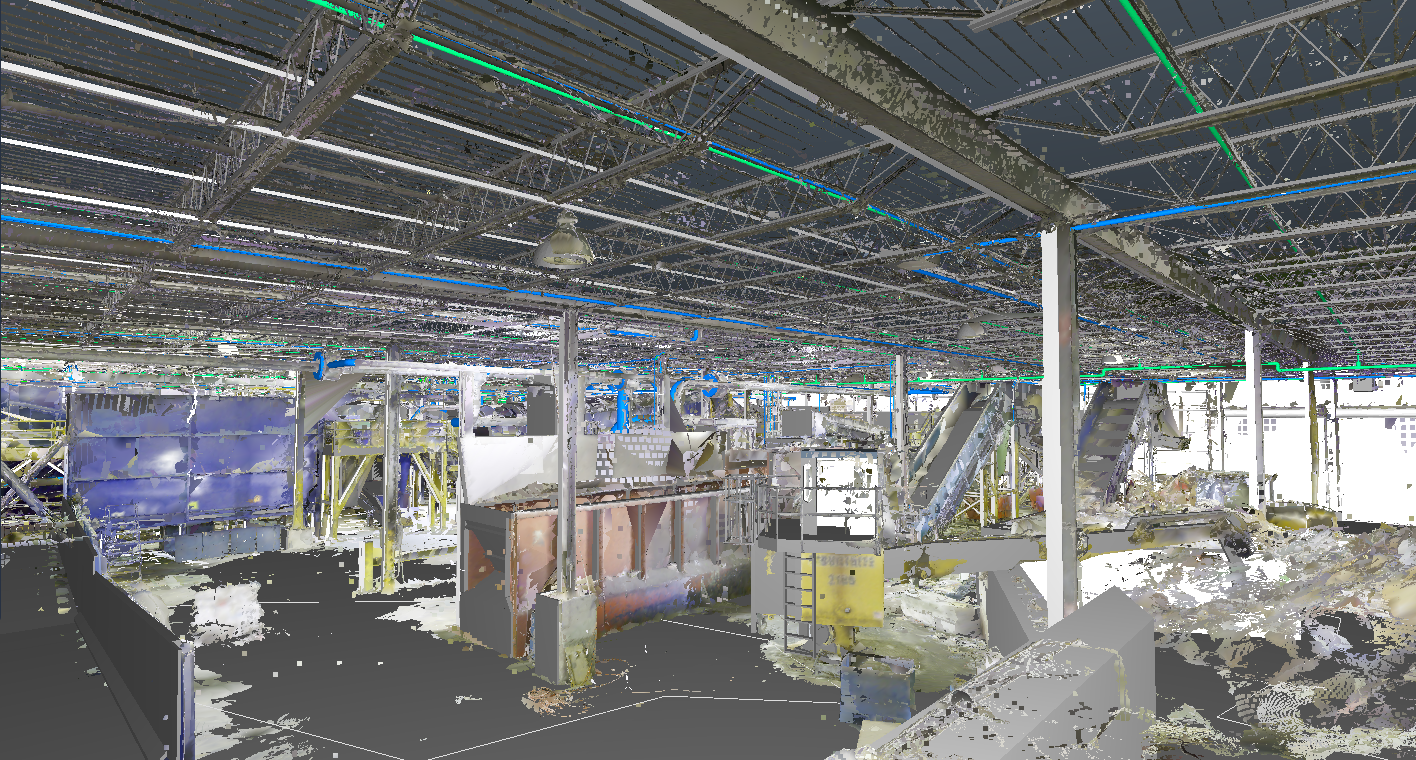
Instead of planning around legacy drawings, teams are shifting toward verified existing conditions captured through high precision 3D laser scanning.
This approach creates a reliable digital representation of the facility as it exists today. Not as it was drawn years ago.
When design teams coordinate within a model built on verified reality, constraints can be addressed early. Interferences can be resolved before installation. Fabrication models can align with field conditions.
That shift changes the trajectory of the project.
Beyond Scan Only Deliverables
Many facilities have worked with survey teams or scan providers who deliver point clouds or raw models. Accurate data capture is essential, but data alone does not reduce risk.
The real value comes from how that data is applied.
Our role is not limited to capturing geometry. We work alongside owners, engineers, mechanical contractors, and equipment manufacturers to ensure the captured data is integrated into coordination, planning, and execution workflows.
Design teams build directly within coordinated 3D environments using platforms such as Revit, AutoCAD, Autodesk Construction Cloud, Inventor, and SolidWorks.
Equipment models are validated within real spatial constraints. Structural conflicts are identified during coordination. Installation sequencing is reviewed against actual geometry.
That is what turns reality capture into project control.
Establishing a Common Data Environment
Technology alone does not solve coordination problems. Process does.
By implementing a structured Common Data Environment (CDE), teams gain:
- A shared source of truth
- Reduced version confusion
- Parallel coordination across disciplines
- Earlier visibility into risk
When multiple stakeholders operate inside a shared environment, communication improves. Accountability improves. Decision cycles shorten.
In complex MRF modernization programs, this level of clarity is not a luxury. It is a requirement.
Bridging Manufacturing and AEC Workflows
MRF modernization often involves tight integration between equipment manufacturers and AEC teams.
Historically, interoperability between platforms such as Inventor and SolidWorks and AEC software like Revit and CAD has been difficult. Model exchanges required simplification. Coordination required manual adjustments.
While tools have improved, integration still demands experience.
We work directly with both manufacturing and AEC teams to ensure equipment models integrate properly within building environments without compromising constructability or performance.
The objective is straightforward. Reduce friction between disciplines so decisions can be made earlier and with confidence.
Measurable Impact in the Field
When retrofit programs adopt coordinated 3D workflows grounded in verified existing conditions, the results show up in execution.
- Fabrication models align with field reality before materials are cut.
- Equipment arrives onsite with validated clearances.
- Shutdown windows become shorter and more predictable.
- Installation crews spend less time adjusting and more time building.
- RFIs decrease because conflicts are resolved during coordination.
- Return visits for re-verification are minimized.
Risk does not disappear. It becomes manageable.
For execution focused teams, that directly protects labor productivity and schedule certainty.
For integration focused teams, it improves decision quality and stakeholder confidence.
The Real Transformation
The most important shift is not from 2D to 3D. It is from hoping drawings are accurate to knowing conditions are verified.
From reacting in the field to resolving constraints during coordination.
From fragmented communication to structured collaboration.
As MRFs continue to modernize, this approach is becoming standard practice. Not because it is trendy, but because the cost of relying on incomplete information is too high.
Projects rarely fail because of equipment. They fail when early decisions are made on incomplete information.
Our role is to provide the verified data and coordinated environments that allow teams to modernize facilities with confidence, clarity, and control.