
Every industrial facility owner has heard a version of this story, or lived it: a manufacturing plant schedules a two-week shutdown for a major retrofit. Equipment arrives on time. The contractor crews are staged and ready. Then, on day three, someone discovers that the new conveyor line conflicts with an overhead conduit run that never made it into the drawings. The conduit has to come down. An electrician has to be sourced on short notice. What was a two-week window becomes three and a half, and the extended shutdown costs more than the original project budget anticipated.
Clash detection industrial construction protocols exist precisely to prevent this. When they are skipped or treated as optional, the costs tend to surface in the worst possible place: the field, during active work, when changing anything is most expensive. This post looks at where those costs come from, how large they can grow, and what it takes to catch conflicts before they become crises.
Table of Contents
What Clashes Actually Cost in Industrial Settings
The construction industry broadly appears to carry enormous losses from coordination failures. One widely cited figure, drawing on industry data, suggests that the U.S. construction industry reportedly loses around $177 billion annually to rework and inefficiency, with trade contractors absorbing a disproportionate share of that burden. Whether the precise number holds up across every project type, the directional reality seems consistent: rework is one of the most expensive line items in construction, and it tends to cluster around coordination gaps.
In standard commercial construction, a clash discovered in the field is expensive. In an industrial or manufacturing environment, it is frequently catastrophic. The difference comes down to several compounding factors.
Industrial facilities typically operate with narrow or fixed shutdown windows. A food production plant, a recycling and material recovery facility, or a heavy manufacturing site cannot simply pause operations indefinitely while coordination problems get resolved. Every additional shutdown day has a calculable cost tied directly to lost throughput. When coordination issues force schedule extensions, that cost lands immediately on the facility owner’s balance sheet.
Industrial environments are dense. Existing infrastructure, including structural steel, process piping, electrical conduit, HVAC systems, conveyors, and floor-mounted equipment, occupies space in ways that as-built drawings often fail to capture accurately. New equipment or systems have to thread through that existing infrastructure with precision. When the verified dimensions of the existing space were never captured, clearance assumptions are exactly that: assumptions.
Change orders in industrial retrofits tend to be large. A conflict involving a structural element, a process line, or a high-voltage electrical run does not resolve with minor field adjustments. It may require re-engineering, re-procurement, and re-scheduling across multiple trades. The cost of a single significant conflict discovered in the field can easily exceed what a complete pre-construction clash detection and coordination process would have cost.
Where Clashes Come From
Understanding why clashes happen in industrial settings is useful for understanding why they are so preventable. The root causes tend to fall into a few recurring patterns.
Outdated existing conditions documentation
This is the most common source. Industrial facilities are built over decades. Equipment gets moved, systems get rerouted, structures get modified. The documentation rarely keeps pace. When a design team works off drawings that are five, ten, or twenty years old, they are designing into a version of the facility that no longer exists. Conflicts between new designs and actual existing conditions are not just possible under those circumstances. They are nearly inevitable.
Trade coordination gaps
Structural, mechanical, electrical, civil, and process engineering teams often work in relative isolation, particularly on complex industrial projects where each discipline has its own specialized documentation and workflow. When those models or drawing sets are not integrated and reviewed together against a common spatial reference, conflicts between disciplines go undetected until the field.
Clearance assumptions
Industrial equipment has specific clearance requirements for maintenance access, safety egress, regulatory compliance, and operational function. Those requirements are often documented at the equipment level but not coordinated spatially against everything else that occupies the same area. A piece of equipment may fit its designated footprint and still conflict with a required maintenance pathway or a code-required egress route.
What Clash Detection Actually Prevents
Thorough clash detection, done with accurate existing conditions data and properly integrated multi-discipline models, prevents the field discovery of conflicts. The downstream effects of that prevention are significant.
Schedule integrity is the most immediate benefit. When conflicts are found in the model, they can be resolved at a fraction of the cost of resolving them during active construction. For industrial projects with fixed shutdown windows, this is often the difference between a project that succeeds and one that produces a loss.
Change order reduction follows directly. According to reports about 4D BIM adoption, BIM-based coordination and scheduling tools are becoming increasingly standard practice among U.S. contractors, in part because they demonstrably reduce the change orders and field conflicts that erode project margins. For facility owners negotiating contracts, reduced change order exposure translates to more predictable total project cost.
Trade coordination quality improves when all disciplines are working against the same spatially accurate model. For industrial facilities where long-lead equipment and custom fabrication are common, a conflict discovered after a duct system has been fabricated or a structural element has been cut is orders of magnitude more expensive than the same conflict found during model review.
What We See on Industrial Projects
Our team works across industrial environments where coordination failure is most costly: recycling and material recovery facilities, manufacturing plants, food production, and heavy industrial retrofits. These are facilities where precision, coordination, and speed all matter simultaneously.
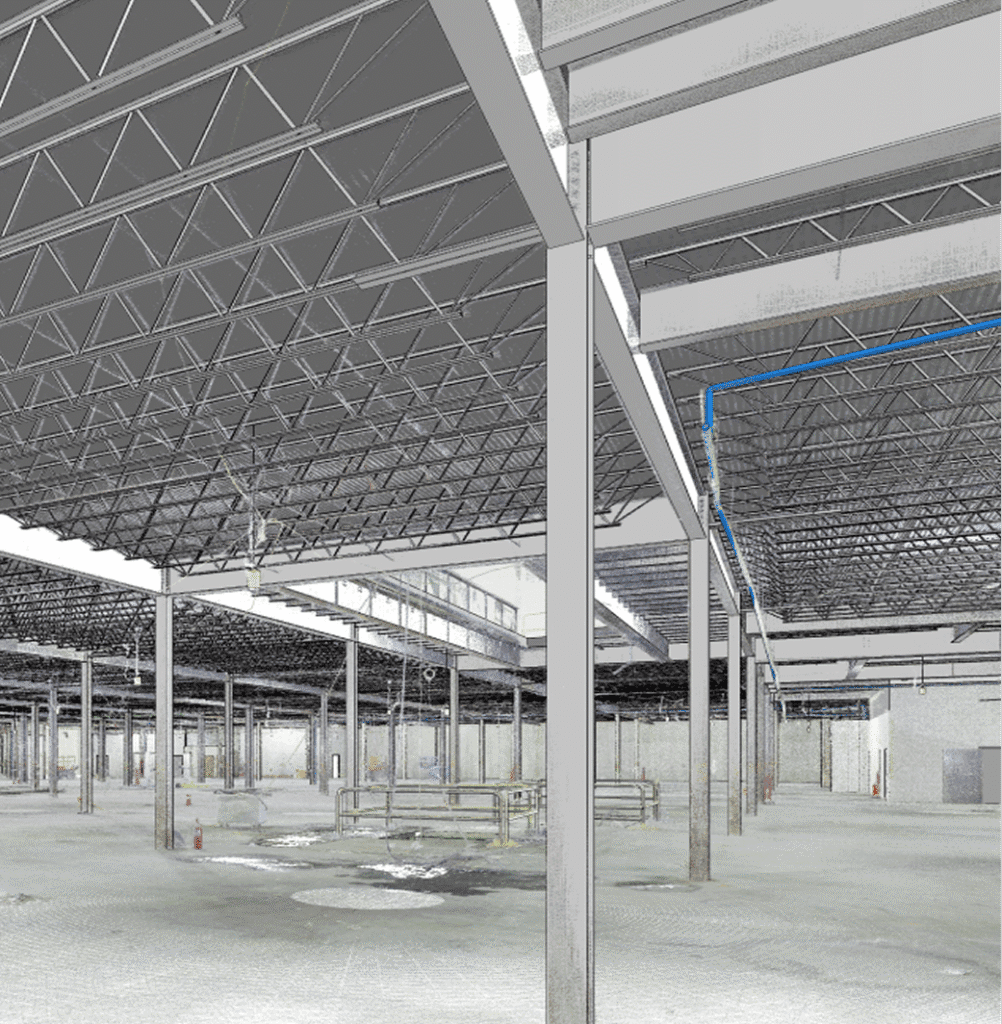
The starting point is almost always existing conditions capture. Design and coordination work that proceeds from inaccurate existing conditions data is building on a faulty foundation, regardless of how thorough the downstream coordination process is. High-density 3D laser scanning captures verified, millimeter-accurate spatial data of the existing facility, giving every discipline a shared, accurate spatial reference before design begins.
One aspect that is particularly relevant for industrial clients is the ability to scan during live operations. Industrial facilities often cannot shut down for an extended survey period. Scanning within operating environments, capturing full facility conditions without requiring production shutdowns, is often what makes accurate existing conditions capture feasible at all.
Once existing conditions are captured, a coordinated multi-discipline model brings structural, mechanical, civil, and environmental data into a single coherent spatial reference. Systematic clash detection across all discipline combinations, prioritized by severity and schedule impact, allows project teams to resolve conflicts in the model before they reach the field.
The Coordination Investment
Every project resolves its conflicts eventually. The question is whether those conflicts get resolved in the model, where changes cost hours, or in the field, where changes cost weeks with full crews standing by and production revenue at risk.
Our observation, working across industrial project types, is that the teams who treat coordination as a cost center tend to discover its value the hard way. The teams who treat it as a risk management tool tend to arrive at project close-out with tighter margins, shorter schedules, and fewer surprises.
The coordination investment is not what makes an industrial project expensive. The lack of it is.
FAQs (Frequently Asked Questions)
What is clash detection in industrial construction?
Clash detection is the process of identifying conflicts between building systems, equipment, and structural elements in a digital model before construction begins. In industrial settings, this means checking new designs against verified existing conditions to ensure that new equipment, piping, electrical systems, and structural elements do not conflict with each other or with existing infrastructure. Conflicts found in the model cost a fraction of what they cost to resolve in the field.
Why is clash detection more critical for industrial projects than commercial construction?
Industrial facilities typically operate with fixed shutdown windows where every additional day of downtime has a direct, calculable cost in lost production revenue. The environments are also denser, with process piping, structural steel, conveyors, and electrical systems occupying space in ways that as-built drawings rarely capture accurately. Change orders in these environments tend to be large because conflicts often involve structural elements or process lines that require re-engineering, not just minor field adjustments.
What causes most clashes on industrial retrofit projects?
The most common cause is outdated existing conditions documentation. Industrial facilities change over decades through equipment relocations, system reroutes, and structural modifications that are rarely reflected in the record drawings. When design teams work from documentation that is five, ten, or twenty years old, they are designing into a version of the facility that no longer exists. Trade coordination gaps and unverified clearance assumptions are the other recurring sources.
Can industrial facilities be scanned during live operations?
Yes. Industrial facilities often cannot shut down for an extended survey period, so the ability to scan during live operations is frequently what makes accurate existing conditions capture feasible. Teams equipped and trained to work within operating environments can capture full facility conditions without requiring production shutdowns, which is critical for continuous-operation facilities.
How much does skipping clash detection cost on an industrial project?
The cost varies by project, but a single significant conflict discovered in the field during an industrial retrofit can easily exceed the cost of a complete pre-construction clash detection and coordination process. When shutdown windows extend due to coordination failures, every additional day carries direct production revenue loss in addition to the added construction costs for re-engineering, re-procurement, and re-scheduling across multiple trades.
If your facility is planning a retrofit, expansion, or equipment installation and you want to understand what thorough clash detection and 3D coordination would look like for your specific environment, our team can walk through it with you.
Send Us A Message.