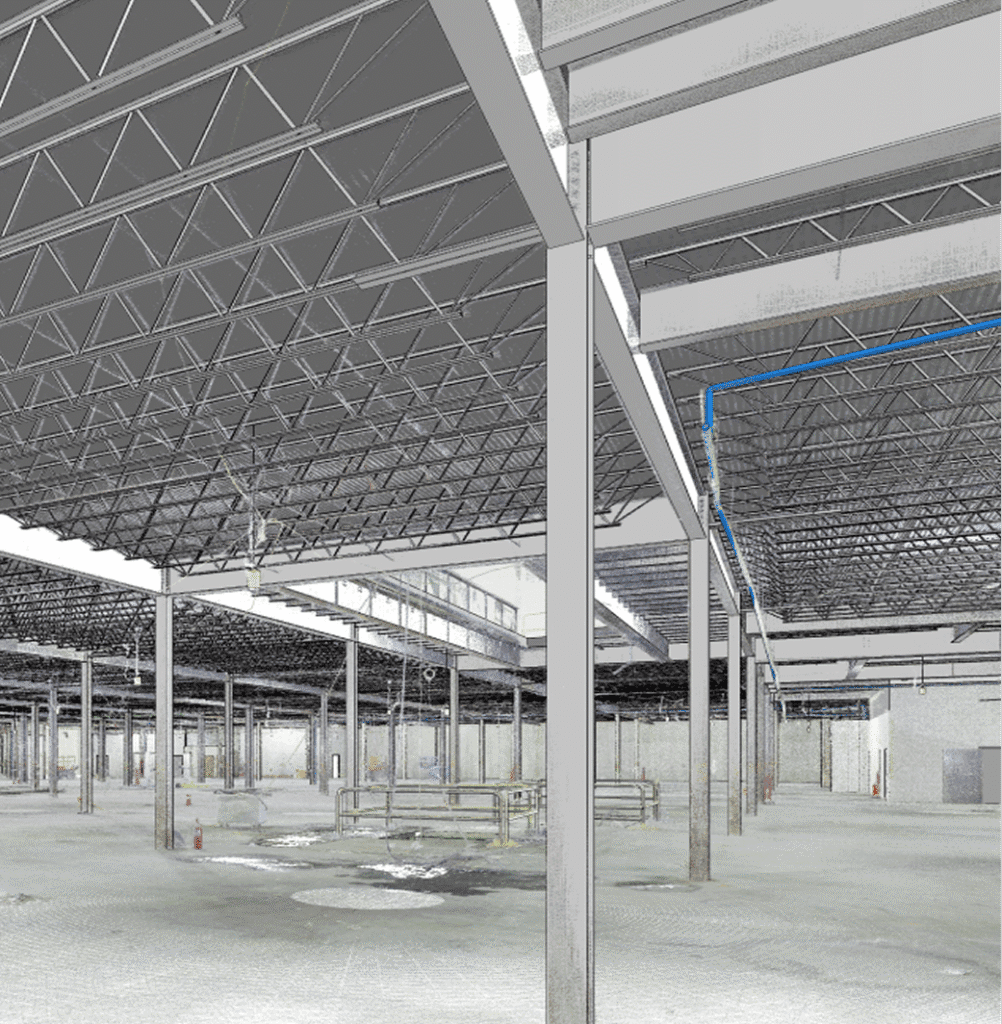
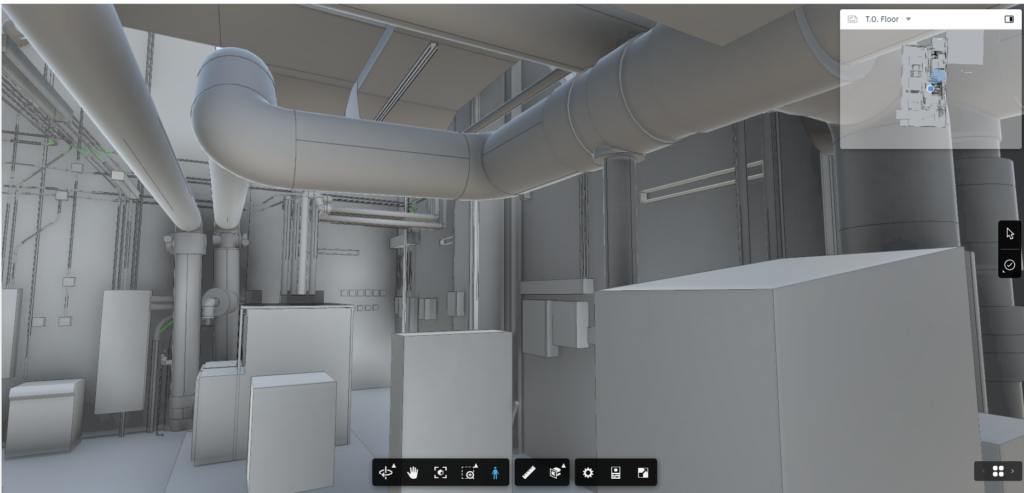
Digital twins generate strong interest across industrial and construction environments because the promise is practical. A reliable digital representation of a facility that supports planning, coordination, maintenance, and future upgrades.
Owners expect stronger capital planning. Engineers expect clearer coordination. Operations teams expect fewer surprises during shutdowns and retrofits.
Yet many digital twin initiatives lose momentum after the initial rollout. The model exists. The data is there. The investment has been made. But daily decision-making does not meaningfully change.
The difference is rarely software capability or scan accuracy. The difference is whether the digital twin becomes embedded in real workflows.
A digital twin only delivers value when teams consistently use it to reduce uncertainty before decisions are locked in.
Table of Contents
Start With the Decision, Not the Model
The most common mistake in digital twin initiatives is starting with the goal of creating a complete model.
A more effective starting point is identifying where uncertainty is currently creating cost, delay, or operational risk.
High-impact areas often include:
- Congested mechanical rooms
- Retrofit zones with outdated documentation
- Production lines with tight tolerances
- Utility corridors with layered modifications over time
- Shutdown scopes where timing is critical
Instead of asking how to build a comprehensive twin, ask:
- Which decisions are currently made with incomplete information?
- Where does rework typically originate?
- Where does coordination break down between disciplines?
When a digital twin is built around specific decision points, adoption becomes natural because the tool solves a visible problem.
Verified Reality Is the Foundation
Digital twins begin with accurate representation of existing conditions. In industrial and retrofit environments, legacy drawings rarely reflect current reality. Equipment shifts. Field modifications accumulate. Documentation falls behind.
Verified reality changes the baseline.
Capturing accurate geometry through laser scanning provides a dependable reference. However, raw point clouds alone do not drive adoption. The information must be translated into coordination-ready outputs that align with how teams already work.
When the data is accessible, structured, and aligned with planning workflows, it becomes usable rather than overwhelming.
Accuracy builds trust. Usability builds adoption.
Integrate the Digital Twin Into Coordination Workflows
Adoption accelerates when the digital twin becomes part of standard coordination processes.
For example:
- Preconstruction meetings reference the model to validate existing constraints.
- Ownership, contractor, lead engenieer or ORA ensures all stakeholders have access to the latest, most accurate, version of the twin or model shop drawing reviews confirm clearances before fabrication begins.
- Shutdown planning sessions use accurate geometry to define sequencing.
- Cross-discipline coordination reviews identify conflicts before material commitment.
When teams rely on verified reality during these moments, the digital twin shifts from a reference asset to a decision tool.
This shift protects margin and schedule. Conflicts are discovered earlier. Assumptions are replaced with validation.
The timing matters. Risk is far less expensive when identified before procurement and mobilization.
Make Adoption Practical and Incremental
Large-scale transformation rarely succeeds through mandate alone. Adoption works best when it is incremental and tied to visible outcomes.
A practical path often looks like this:
- Select a high-risk project or area.
- Capture verified existing conditions.
- Convert that data into usable coordination models.
- Apply the model directly within active planning discussions.
- Document avoided conflicts and smoother execution.
When teams experience fewer surprises in the field, skepticism decreases. Confidence builds organically.
Over time, the digital twin expands beyond a single project and becomes a repeatable capability across facilities.
A digital twin reflects reality at a specific moment in time. Facilities evolve. Equipment moves. Systems are upgraded.
Define Ownership and Update Strategy Early
Without a defined update strategy, confidence erodes.
Before launching a digital twin initiative, leadership teams should clarify:
- Who owns the model long term?
- How will updates occur after capital projects?
- How frequently will reality capture be refreshed in high-change areas?
- How will contractors be required to reference the digital twin during design and execution?
Clear ownership prevents fragmentation. Defined update processes preserve credibility.
When teams trust that the digital twin reflects current conditions, they are more likely to use it consistently.
Focus on Reducing Decision Risk
Digital twins become strategic when they consistently reduce decision risk.
That reduction appears in tangible ways:
- Fewer fabrication conflicts
- Fewer field modifications
- Stronger shutdown planning
- Improved cross-trade coordination
- Greater confidence in early-stage capital planning
These outcomes are measurable in cost, schedule stability, and operational continuity and speed of the project overall.
Technology enables the environment. Adoption delivers the outcome.
When the digital twin supports coordination and planning before crews mobilize, it influences the most critical phase of project risk.
The Role of a Turnkey Partner
Many organizations understand the value of verified reality but lack internal bandwidth to manage scanning, modeling, coordination integration, and lifecycle updates.
A turnkey partner supports the full sequence:
- Capture accurate existing conditions
- Translate data into coordination-ready models
- Support planning and validation workflows
- Align outputs with real project constraints
- Make data accessible to key stakeholders
- Ensure a unified data set for AI training
Continuity matters. When one accountable partner supports both data accuracy and applied coordination, the digital twin remains cohesive and aligned with decision-making.
The objective is straightforward. Replace assumptions with verified reality, then apply that reality to strengthen early decisions.
From Asset to Operational Capability
A digital twin becomes valuable when it transitions from a deliverable to a capability.
This shift happens when:
- Teams consistently validate conditions before fabrication
- Coordination conflicts surface during planning rather than installation
- Shutdown strategies rely on accurate geometry
- Project teams reference verified reality as a standard practice
Over time, the organization begins to plan differently. Early decisions carry more confidence. Risk conversations move upstream.
The digital twin stops being an initiative. It becomes part of how work gets done.
Long-Term Impact Across Facilities
In industrial environments, uncertainty compounds across projects. Each retrofit, expansion, or shutdown introduces exposure.
When verified reality and coordination workflows are embedded into planning processes, uncertainty is identified earlier. Adjustments occur when they are less disruptive and less expensive.
The impact compounds across years, not just projects.
A digital twin that teams actually use strengthens planning culture, improves cross-functional alignment, and reinforces accountability.
As companies seek to apply AI to process, operations, and asset management, the effectiveness of AI deployment will be only as good as the data is valid and reliable.
It supports operational continuity while protecting capital investment.
Conclusion
Building a digital twin that teams actually use requires clarity of purpose and alignment with real workflows.
Start with the decisions that carry the most risk. Capture verified reality that reflects current conditions. Translate that data into usable formats. Integrate it into coordination and planning sessions. Define ownership and update processes.
When the system supports daily work rather than sitting alongside it, adoption follows naturally.
The result is not simply a model. It is stronger decision confidence before execution begins.