
Remodel and renovation projects carry more uncertainty than most other construction work. Existing buildings and especially old ones, often include undocumented alterations, legacy systems, hidden conditions, and structural changes made over decades. Yet General Contractors are still expected to price, schedule, and coordinate these projects based on drawings that oftentimes don’t reflect reality.
This disconnect between plan documents and field conditions is one of the primary drivers of change orders, RFI spikes, and preconstruction volatility. For GCs delivering remodel & fit up heavy portfolios, this risk is unavoidable but verifying existing conditions early in the project can reduce that risk considerably
Scan-to-BIM provides the accuracy required to stabilize remodel workflows, remove early conflicts, and improve predictability across the entire project lifecycle.
The unique risk profile of remodel and renovation work
Unlike new construction, remodel projects begin with incomplete information. GCs must evaluate conditions that are concealed behind walls, ceilings, and equipment—without the benefit of accurate as-builts. Typical risks include:
- Undocumented electrical and mechanical modifications
- Deviations from original structural plans
- Slab elevation inconsistencies
- Above-ceiling surprises such as conduits or fire protection runs
- Conflicts between current layouts and past tenant improvements
Relying on outdated drawings forces contractors to make assumptions, and assumptions often change orders.
Why outdated drawings fail GCs during preconstruction
Even when drawings exist, they rarely represent the building as it stands today. Over time, buildings evolve:
- Tenants add systems without updating plans
- Mechanical and electrical equipment is replaced
- Structural elements are modified
- Equipment is relocated, added, or removed
- Ceiling plenum conditions shift
When preconstruction teams base design and estimating decisions on inaccurate drawings, they introduce risk into every downstream phase—design, coordination, demo, and build-out.
Scan-to-BIM eliminates this uncertainty by providing verified existing conditions that reflect the building as it is today.
What Scan-to-BIM delivers for remodel projects
1. Verified existing conditions
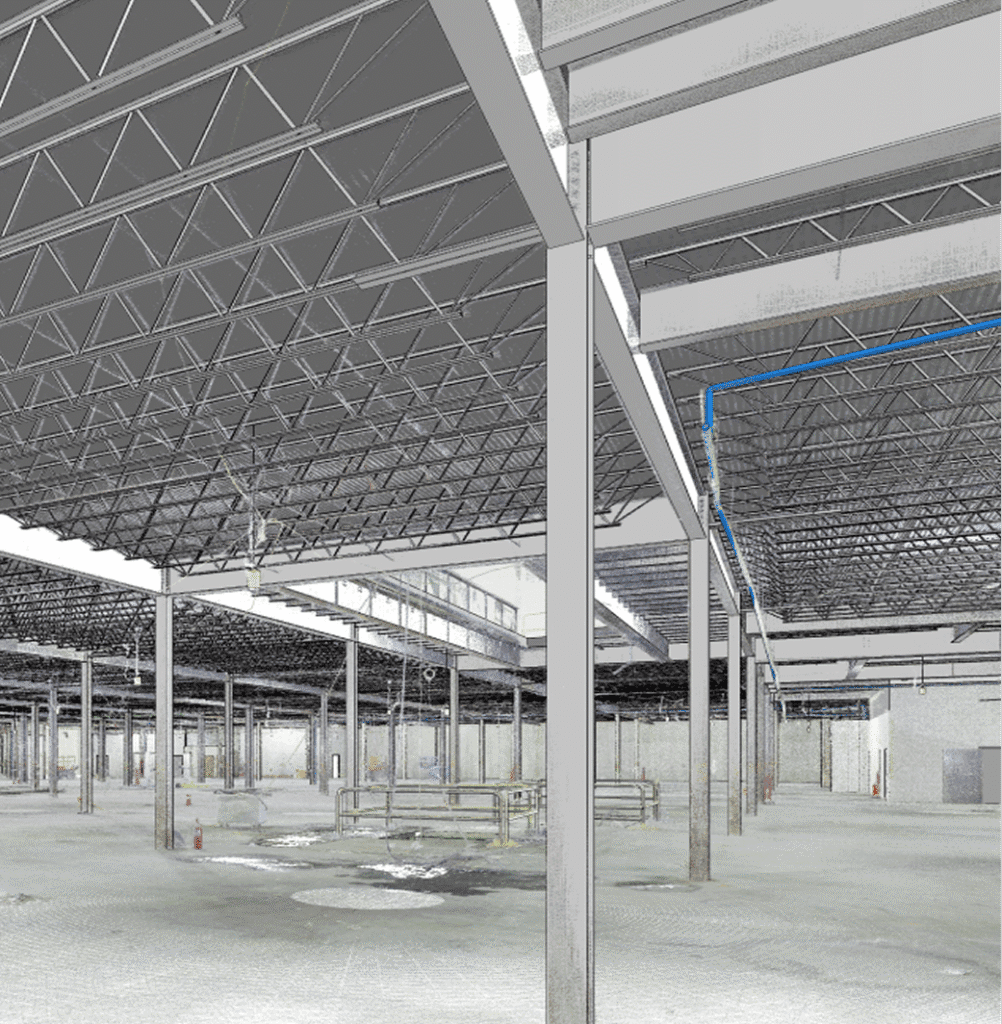
High-resolution LiDAR captures precise geometry of the building’s structure, MEP systems, and architectural features. This data becomes the foundation for a coordinated remodel plan.
2. A precise BIM model for coordination
The scanned geometry is converted into a BIM model that accurately represents the true state of the facility. All stakeholders—GCs, architects, MEP engineers, and subs—can work from a single, reliable dataset.
3. Elimination of early field conflicts
Clashes that would normally emerge after demo are discovered during preconstruction, including:
- Unexpected ductwork and piping
- Structural shifts or nonstandard framing
- Mislabeled or undocumented utilities
- Elevation differences not shown in drawings
Discovering these issues early enables proactive resolution instead of emergency field changes.
4. Improved cost and schedule accuracy
GCs can estimate labor, materials, phasing, and demo scope with far greater accuracy. Contingencies decrease because scope becomes clearer earlier in the process.
How Scan-to-BIM reduces change orders before Day One
Change orders in remodel work often originate from conditions that were unknown at the time of bidding. Scan-to-BIM resolves these issues before the GC steps onsite.
Benefits include:
- Early detection of structural and MEP conflicts
- Reduced reliance on allowances and exploratory demo
- Fewer RFIs driven by missing or inaccurate information
- Better sequencing and phasing decisions
- Stronger alignment between design intent and field reality
The result is a measurable reduction in change orders attributed to “unforeseen conditions”—because those conditions are identified before the contract is signed.
Operational value for remodel-focused GCs
Scan-to-BIM offers clear operational benefits:
- Greater design accuracy
- Reduced rework and field corrections
- More stable preconstruction planning
- Improved trade coordination
- Fewer disruptions during demo
- Stronger client confidence due to fewer surprises
For GCs managing complex renovations, the reliability of accurate as-builts directly improves project outcomes.
Conclusion
Remodel projects depend on an accurate understanding of existing conditions. Scan-to-BIM provides GCs with the verified geometry necessary to eliminate early conflicts, reduce change orders, and strengthen preconstruction planning.
With better data, GCs deliver more predictable schedules, more accurate budgets, and a smoother overall remodel process.
If your team needs accurate as-builts before design or demo, we can help.
FAQs
What is Scan-to-BIM for remodels?
A process that captures existing building conditions using LiDAR and converts the data into a BIM model for accurate design and coordination.
Why do GCs use Scan-to-BIM?
It identifies hidden conditions early, reduces change orders, and improves preconstruction accuracy.
How accurate is Scan-to-BIM for renovation work?
High-resolution LiDAR captures geometry within millimeters, far more reliable than legacy drawings or manual measurements.
What remodel challenges does Scan-to-BIM address?
Hidden utilities, structural modifications, elevation inconsistencies, and undocumented tenant improvements.
When should Scan-to-BIM be performed?
At the start of preconstruction—before design development, coordination, or demo.