
Laser Scanning and BIM Coordination for HVAC & Mechanical Contractors
HVAC and mechanical contractors operate on tight margins. Field conflicts, coordination failures, and rework are the fastest way to lose profit on a project. OAR provides 3D Laser Scanning, Scan to BIM, BIM Coordination & Virtual Construction, and Digital Delivery & Implementation services that give your team verified existing conditions, clash-free models, and fabrication-ready data before your crew ever touches ductwork.
Based in Portsmouth, New Hampshire, OAR serves HVAC and mechanical contractors across the Northeast: Connecticut, Massachusetts, Maine, New Hampshire, New York, Rhode Island, and Vermont. BIM Coordination, Virtual Construction, and Digital Delivery are delivered remotely nationwide.
Every system fits in the model before your crew picks up a wrench.
Ductwork That Fits the First Time
Tight ceiling plenums, unknown obstructions, and inaccurate drawings lead to field modifications that blow your budget.
We scan the space, build the coordination model, and resolve clashes before you order material or cut sheet metal.
Your Installers Work from Resolved Information
Every open question on a set of drawings costs your crew time. When your foreman is on a ladder trying to figure out where the hanger goes because the coordination drawing does not account for a conduit run that was never modeled, that is an RFI waiting to happen.
We resolve those conflicts in the model, so your installation crew works from solid information.
Coordination Bandwidth Without the Overhead
Your team knows how to install mechanical systems. What most mechanical contractors do not have is the bandwidth to run full BIM coordination on top of an active installation schedule.
We add that coordination capacity to your operation, so your project engineers and superintendents stay focused.
Accurate Quotes, Protected Margins
When you bid from verified existing conditions instead of questionable drawings, your material takeoffs are tighter. Your quotes carry less contingency. Your pricing is more competitive because it reflects what is actually there, not what someone drew ten years ago.
Most mechanical coordination failures trace back to inaccurate existing conditions.
Outdated drawings, missing clearance data, and field-measured assumptions create conflicts that don’t surface until installation. At that point, fixing them costs three to five times more than preventing them.
HVAC contractors working in occupied commercial buildings, industrial retrofits, and complex mechanical rooms face this challenge on every project. The tolerance for field error is zero when ductwork and piping are being prefabricated offsite.
The fix is not more field time. It is verified data before fabrication starts.
Three services. One partner.
3D Laser Scanning for Existing Conditions
Millimeter accuracy. No guesswork.
OAR captures existing mechanical rooms, ceiling plenum spaces, structural elements, and equipment clearances with millimeter-level accuracy. The resulting point cloud replaces manual field measurements and gives your team verified geometry for coordination and fabrication.
Scan to BIM for Mechanical Systems
Point cloud to fabrication-ready model.
We convert point cloud data into Revit-based coordination models that reflect actual field conditions. These models feed directly into your mechanical and sheet metal coordination workflows, clash detection, and fabrication drawing production.
Mechanical & Sheet Metal Coordination
Conflicts resolved before they reach the field.
OAR’s BIM Coordination & Virtual Construction services manage clash detection, constructability review, and trade coordination for mechanical and sheet metal systems. We work alongside your project team to resolve conflicts before they reach the field.
Project types we support.
OAR partners with HVAC and mechanical contractors across a range of project types. If your work involves prefabrication, complex existing conditions, or BIM coordination requirements, we can help.
Mechanical coordination for commercial build-outs and tenant improvement projects with complex existing conditions and tight ceiling plenums.
Existing conditions capture and coordination for industrial facility retrofits where documentation is missing, outdated, or unreliable.
Scan-accurate Revit models that give fabricators verified field geometry before a single piece is cut. Assemblies fit because the data was verified first.
Strict clearance requirements, infection control zones, and complex MEP systems in occupied facilities. We work around your operational constraints.
Mechanical coordination as part of OAR’s broader BIM Coordination & Virtual Construction scope. One partner from scan to coordinated model delivery.
Five deliverables. One accountable partner.
3D Laser Scanning that captures what is actually in the field, not what the drawings say should be there. Point clouds in .RCP, .RCS, or .E57 format, ready for your coordination workflow.
3D models built from point cloud data and aligned to actual field geometry. LOD 200-350 depending on your project requirements. Ready for clash detection and fabrication.
Every conflict identified and resolved in the model before a single piece of ductwork or piping is fabricated or ordered. Hard clashes, soft clashes, and clearance violations all flagged and tracked.
Shop drawings based on scanned field conditions so prefabricated assemblies fit during installation. Produced from verified Revit models, not design intent drawings.
OAR owns the full chain from site scan to coordinated model. No handoff gaps between the scanning team and the BIM team. One partner responsible for the outcome.
Mechanical coordination in the field.
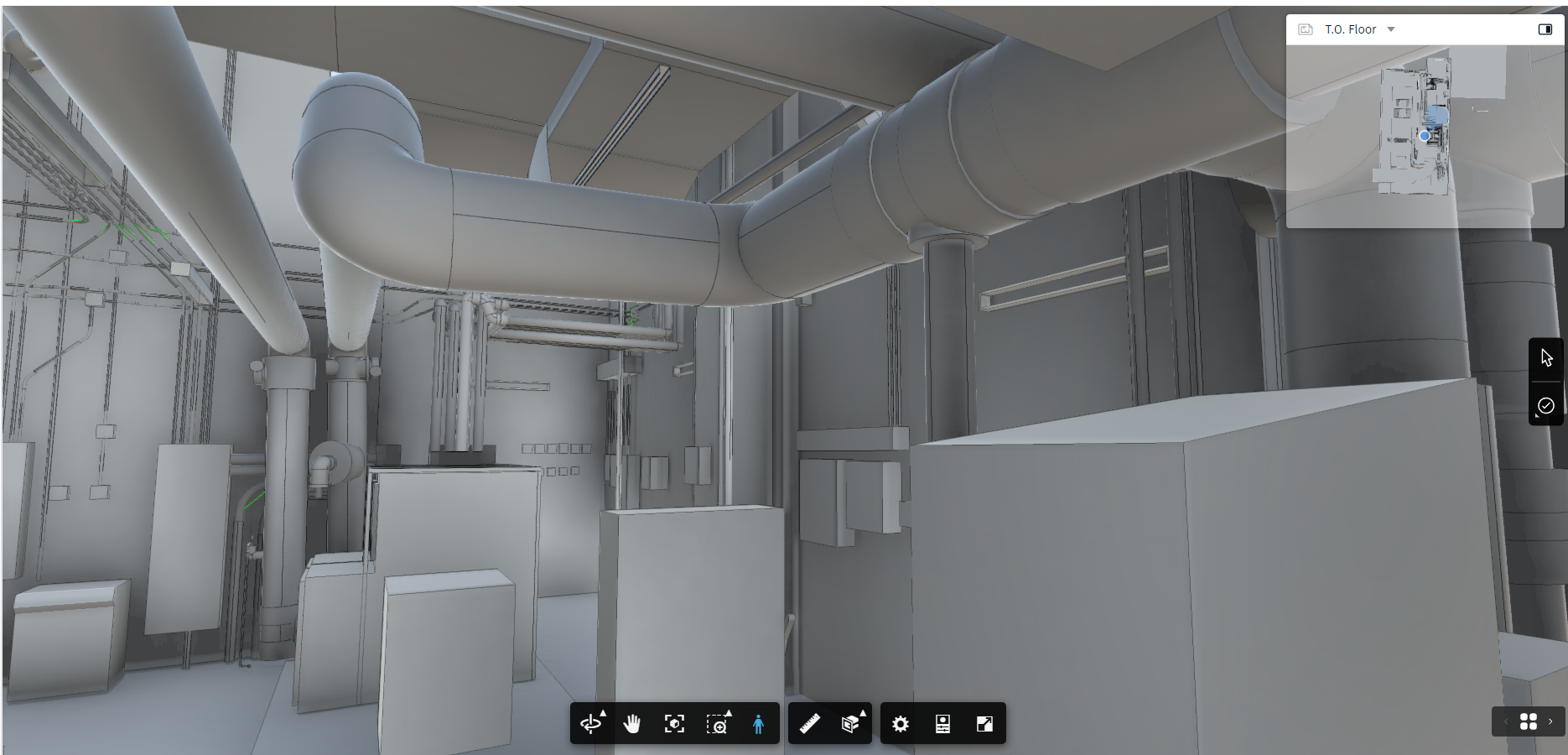
Mechanical Room Coordination Chiller Installation
New England · Education / MEP · Active Facility
Existing conditions model
Field conflicts at installation
SF scanned
Existing-conditions laser scan and LOD 300 model of a mechanical room, roof, and adjacent gym areas to validate constructability and coordinate installation of a new chiller. Tight space, no prior documentation. OAR delivered a coordinated MEP model with clash detection, giving the installation team verified existing conditions and a clear installation sequence.
LOD 350 Existing-Conditions and MEP Interference Modeling for a Chiller Replacement Inside an Operational School
From the field.
Posted on Google
 Maxwell Capon
Trustindex verifies that the original source of the review is Google.
Jon and his team were great! Very response and the deliverables were exactly what we needed!Posted on Google Chris HerrmannI hired OAR to scan a 14,000 mixed-use retail and office building that I purchased and needed a solid set of 2D drawings of. This proved to be a cost effective way to get those, plus SOOO much more. The level of detail they produced is exceptional and will save time and cost for many years to come. They did what they said they were going to, were very accommodating of tenants in an existing and fully occupied building, and were great to work with in general. I would highly recommend them to anyone with a similar need.Posted on Google
 eturbo924OAR has proven to be an exceptional partner that has truly revolutionized our operations. We've had the pleasure of collaborating with Ryan and his team, and their expertise has been pivotal in addressing complex challenges related to software interoperability, design enhancement, and workflow streamlining. The transition from conventional 2D design to the dynamic world of 3D and BIM was made possible and seamless through OAR's unparalleled contributions. One of the standout features of OAR's service is their remarkable scan-to-BIM capability. The precision and accuracy with which they transform real-world scans into comprehensive BIM models is nothing short of remarkable. This aspect alone has elevated the quality of our projects to new heights, enabling us to work with existing conditions in ways we hadn't imagined before. What truly sets OAR apart is not only their exceptional technology, but also their unwavering commitment to delivering excellence. Their service is a true testament to their dedication, as they consistently ensure that the systems we rely on day in and day out operate flawlessly. This level of reliability has undoubtedly accelerated our project timelines, allowing us to make informed decisions based on a newfound depth of existing conditions data. Having partnered with OAR for the past two years, it's clear that they've become an indispensable asset to our success. Their impact on our projects is undeniable, and the transformational journey from our initial engagement to the present day has been nothing short of remarkable. As a small business, OAR's dedication, innovation, and exceptional service have proven that size is no measure of capability. In light of our extraordinary experience, I wholeheartedly recommend OAR without reservation. If you're seeking to leverage the power of laser scanning and BIM, there's simply no better choice. OAR's expertise, passion, and commitment to excellence make them the first and only call you need to make. They don't just deliver a service; they deliver a transformative partnership that propels your projects to unprecedented levels of success.Posted on Google
 Mike OraschewskyProfessional, timely and highly accurate scanning and modeling by OAR has saved me $$$. Having a single 3D source of truth for engineers, OEMs and tradesmen made my last project a breeze.Posted on Google
 Mike OraschewskyI hired OAR to do a pre-construction scan to point cloud mesh and 2D CAD of my new building. I am glad I did: the integrations engineer, GC, subs, and equipment manufacturers (most of whom are overseas) are delighted to have the ability to step into the space and confirm fit and plan my construction intelligently based on onsite conditions. Most importantly - with Jon and Ryan this business goes above and beyond. I had concerns my design/construction group wouldn’t use what OAR provided but Ryan and Jon took the time after they delivered the point cloud and drawings to show my team how to use this tool to make sure it saves my team’s time and by extension: my money in construction. We are making last minute design changes now that if not identified would’ve cost 5 figures $. This technology is exciting to use as a project owner. I’m considering having them back out for an as-built once construction completes. And I’ll always have them do a pre construction scan on any factualities I buy going forward. Thank you OAR.Posted on Google
 Jean-philip GiguèreFast, precise and affordable. They greatly simplify difficult tasks!Posted on Google
 Alex QuarterleyOAR's team has been great to work with throughout multiple large scale scan to BIM projects. High attention to detail, accurate scan data, proper BIM implementation and consistent communication/support from OAR has helped to improve our project quality and efficiency from start to finish.
Frequently asked questions
HVAC contractors working on commercial, healthcare, or industrial projects are increasingly required to participate in BIM coordination and submit coordinated Revit models as part of contract requirements. OAR provides Scan to BIM and mechanical coordination services so HVAC contractors can meet these requirements without building an in-house VDC team.
OAR’s laser scanning captures existing conditions at millimeter-level accuracy, well within the tolerances required for mechanical coordination and prefabrication. Point cloud data reflects actual field geometry, not design intent, which is critical for mechanical systems in occupied buildings or complex retrofit projects.
OAR converts point cloud data into Revit coordination models and can support fabrication drawing production for mechanical and sheet metal systems. Scan-based models ensure dimensions reflect actual field conditions, reducing the risk of prefabricated assemblies that don’t fit during installation.
OAR supports HVAC contractors on commercial tenant improvements, healthcare facilities, industrial retrofits, data centers, and design-build projects. We handle field scanning across the Northeast and take coordination scope work nationwide.
Most commercial mechanical rooms and ceiling plenum areas are captured in one to two days. OAR coordinates access requirements with your project team to minimize disruption to occupied facilities.
Design-intent drawings show what was planned. Scan-based models show what was actually built. On renovation and retrofit projects, the two rarely match. When HVAC systems are fabricated from design-intent drawings that do not reflect actual field conditions, assemblies arrive on site and do not fit. OAR’s scan-based models give fabricators verified geometry to work from.
Yes. OAR’s BIM Coordination & Virtual Construction service manages multi-trade clash detection across mechanical, electrical, plumbing, fire protection, and structural systems. We work with your GC’s coordination program or run the coordination workflow independently when you are the lead trade.
Cost depends on facility size, complexity, and deliverable requirements. 3D Laser Scanning engagements typically range from $8,000 to $60,000. Mechanical coordination projects typically range from $15,000 to $50,000+. A typical single-room or mechanical area scan with LOD 300 Revit model runs $10,000 to $25,000. Send us your project scope for an accurate proposal.