Laser Scanning & BIM Coordination for Engineering & Environmental Firms
Engineering firms without in-house reality capture capabilities spend more time in the field, design against incomplete data, and compete for projects at a significant disadvantage. OAR provides the 3D Laser Scanning, Scan to BIM, BIM Coordination & Virtual Construction, and Digital Delivery & Implementation services that extend your firm’s capabilities rapidly compared with the time it would take to build capabilities internally.
Based in Portsmouth, New Hampshire, OAR serves engineering and environmental firms across the Northeast: Connecticut, Massachusetts, Maine, New Hampshire, New York, Rhode Island, and Vermont. BIM Coordination and Digital Delivery & Implementation are delivered remotely nationwide.
Integrate every data stream.
Design from verified reality.

Multi-Source Data That Actually Connects
Design-Ready Documentation for Complex Sites
Build BIM Capability Without Building a Department
Data Architecture That Keeps Working
Multi-Source Data That Actually Connects
Survey data, aerial LiDAR, geotechnical investigations, environmental sampling, and design models often arrive in incompatible formats from different teams.
We build the integration architecture that connects them into one navigable environment with shared coordinate systems.
Design-Ready Documentation for Complex Sites
Infrastructure rehabilitation, environmental remediation, and occupied facility upgrades require a level of existing conditions documentation that goes beyond a standard survey.
Your design team needs permit-level accuracy, phased site documentation, and deliverables formatted for the regulatory submittals that govern these projects.
Build BIM Capability Without Building a Department
Your firm needs to deliver in BIM, but standing up a full VDC operation takes headcount, software, and workflow infrastructure that takes a long time to build and needs considerable upfront investment.
We help you build that capability into your existing team, so you deliver in BIM on real projects, not just in proposals.
Data Architecture That Keeps Working
The engineering firms getting the most value from their project data are the ones that structured it for reuse from the beginning.
When your data integration systems are built with consistent standards and clear taxonomies, every project you capture becomes part of a growing library your team can reference, compare, and build on.
Three services. One partner.
3D Laser Scanning & Scan to BIM
Verified existing conditions in days, not weeks.
OAR captures complete site geometry using terrestrial laser scanning and delivers point clouds, Revit models, Civil 3D surface models, and as-built 2D CAD drawings at LOD 200-400. Your team designs from verified conditions, not assumptions. One mobilization. Complete data.
BIM Coordination & Virtual Construction
Multi-discipline coordination without building an internal team.
OAR runs clash detection across architectural, structural, civil, and MEP systems and manages the full coordination workflow. Your firm delivers coordinated, clash-free designs without maintaining in-house VDC staff or Navisworks licenses.
Digital Delivery & Implementation
Build the capability. Own the infrastructure.
For firms transitioning from 2D to BIM or building digital delivery capability and advanced services or offerings, OAR provides BIM Execution Plans, Common Data Environment configuration, multi-source data integration, team training, and AI-ready data architecture. You get the systems and knowledge to sustain digital delivery after the engagement ends.
Project types we work on.
Complete facility documentation for renovation design: structural elements, MEP systems, site features, and spatial constraints captured in one mobilization.
Site surveys, topographic capture, and Civil 3D surface models for infrastructure design, grading, drainage, and utility coordination.
Verified facility documentation for environmental engineering projects: equipment locations, utility routing, and structural conditions for sites undergoing assessment, remediation, or repurposing.
As-built documentation and Integrated Project Twin development for waterfront infrastructure, dry docks, and marine facilities with complex multi-discipline coordination requirements.
Unifying laser scan data, geotechnical investigations, environmental sampling, aerial LiDAR, and design models into one coordinated BIM environment with shared coordinate systems.
2D-to-BIM transition consulting, CDE configuration, BIM Execution Plans, and team training for engineering firms building digital delivery capability for the first time.
Design-ready data in your format, on your timeline.
Survey-grade point cloud data at plus or minus 2 to 6mm accuracy. Formats: .E57, .RCP, .RCS, .LAS, .PTS. Compatible with Revit, Civil 3D, MicroStation, Navisworks, and AutoCAD.
Intelligent Revit models with parametric components: architectural, structural, and MEP systems at the level of detail your project requires. Dimensional accuracy verified against the point cloud before delivery.
Plans, elevations, and sections extracted from 3D models. Delivered in .DWG format for teams that need 2D documentation alongside 3D.
Site topography, utility infrastructure, grading geometry, and alignment data for civil infrastructure design. Built from scan data for verified accuracy.
Coordinated BIM environments combining laser scan data, geotechnical investigations, environmental sampling, and design models into a single navigable 3D environment.
Custom BEPs aligned with ISO 19650 and BIMForum standards. Common Data Environment configuration across Autodesk Construction Cloud, BIM 360, BoreDM, and ArcGIS.
BIM implementation for a national engineering firm.
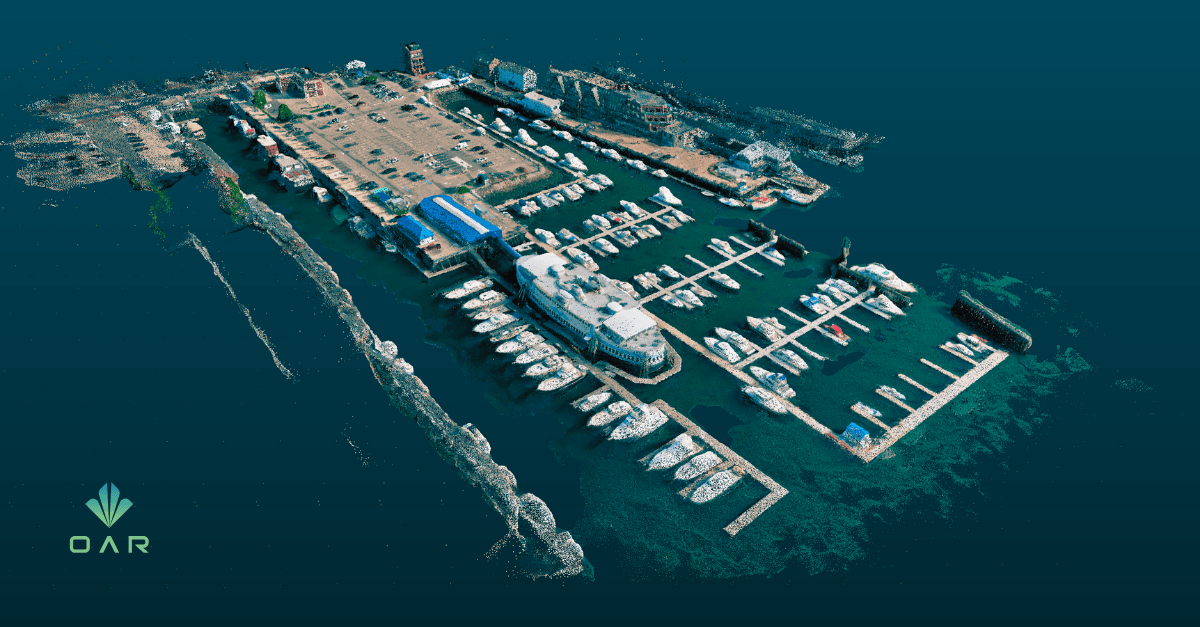
Engineering Firm BIM Transformation First Large-Scale BIM Delivery
Alabama · Shipyard Expansion · Engineering Firm Waterfront Division
Hours logged across five projects
Large-scale project fully delivered in BIM for the client firm
Digital Delivery Maturity transformation initiated
A national engineering firm’s Waterfront Division needed to transition from traditional 2D CAD workflows to a full BIM environment for a major shipyard expansion. They had no prior large-scale BIM project experience. OAR provided consultation, training, and ongoing implementation support. The project became the firm’s first large-scale delivery fully executed in BIM, and served as the proof of concept for a firm-wide Digital Delivery Maturity transformation.
LOD 350 Existing-Conditions and MEP Interference Modeling for a Chiller Replacement Inside an Operational School
Food Production Facility Conversion: Turning 2D Equipment Specs Into a Coordinated, Installation-Ready Model
From the field.
Posted on Google
 Maxwell Capon
Trustindex verifies that the original source of the review is Google.
Jon and his team were great! Very response and the deliverables were exactly what we needed!Posted on Google Chris HerrmannI hired OAR to scan a 14,000 mixed-use retail and office building that I purchased and needed a solid set of 2D drawings of. This proved to be a cost effective way to get those, plus SOOO much more. The level of detail they produced is exceptional and will save time and cost for many years to come. They did what they said they were going to, were very accommodating of tenants in an existing and fully occupied building, and were great to work with in general. I would highly recommend them to anyone with a similar need.Posted on Google
 eturbo924OAR has proven to be an exceptional partner that has truly revolutionized our operations. We've had the pleasure of collaborating with Ryan and his team, and their expertise has been pivotal in addressing complex challenges related to software interoperability, design enhancement, and workflow streamlining. The transition from conventional 2D design to the dynamic world of 3D and BIM was made possible and seamless through OAR's unparalleled contributions. One of the standout features of OAR's service is their remarkable scan-to-BIM capability. The precision and accuracy with which they transform real-world scans into comprehensive BIM models is nothing short of remarkable. This aspect alone has elevated the quality of our projects to new heights, enabling us to work with existing conditions in ways we hadn't imagined before. What truly sets OAR apart is not only their exceptional technology, but also their unwavering commitment to delivering excellence. Their service is a true testament to their dedication, as they consistently ensure that the systems we rely on day in and day out operate flawlessly. This level of reliability has undoubtedly accelerated our project timelines, allowing us to make informed decisions based on a newfound depth of existing conditions data. Having partnered with OAR for the past two years, it's clear that they've become an indispensable asset to our success. Their impact on our projects is undeniable, and the transformational journey from our initial engagement to the present day has been nothing short of remarkable. As a small business, OAR's dedication, innovation, and exceptional service have proven that size is no measure of capability. In light of our extraordinary experience, I wholeheartedly recommend OAR without reservation. If you're seeking to leverage the power of laser scanning and BIM, there's simply no better choice. OAR's expertise, passion, and commitment to excellence make them the first and only call you need to make. They don't just deliver a service; they deliver a transformative partnership that propels your projects to unprecedented levels of success.Posted on Google
 Mike OraschewskyProfessional, timely and highly accurate scanning and modeling by OAR has saved me $$$. Having a single 3D source of truth for engineers, OEMs and tradesmen made my last project a breeze.Posted on Google
 Mike OraschewskyI hired OAR to do a pre-construction scan to point cloud mesh and 2D CAD of my new building. I am glad I did: the integrations engineer, GC, subs, and equipment manufacturers (most of whom are overseas) are delighted to have the ability to step into the space and confirm fit and plan my construction intelligently based on onsite conditions. Most importantly - with Jon and Ryan this business goes above and beyond. I had concerns my design/construction group wouldn’t use what OAR provided but Ryan and Jon took the time after they delivered the point cloud and drawings to show my team how to use this tool to make sure it saves my team’s time and by extension: my money in construction. We are making last minute design changes now that if not identified would’ve cost 5 figures $. This technology is exciting to use as a project owner. I’m considering having them back out for an as-built once construction completes. And I’ll always have them do a pre construction scan on any factualities I buy going forward. Thank you OAR.Posted on Google
 Jean-philip GiguèreFast, precise and affordable. They greatly simplify difficult tasks!Posted on Google
 Alex QuarterleyOAR's team has been great to work with throughout multiple large scale scan to BIM projects. High attention to detail, accurate scan data, proper BIM implementation and consistent communication/support from OAR has helped to improve our project quality and efficiency from start to finish.
Frequently asked questions
Scan to BIM converts 3D laser scan point cloud data into intelligent Building Information Models in Revit, Civil 3D, or MicroStation. For engineering firms, this provides verified existing conditions for renovation, retrofit, and infrastructure design without relying on outdated 2D drawings.
Yes. OAR converts point cloud data into intelligent Revit and Civil 3D models with architectural, structural, MEP, and civil components at LOD 200-400. Dimensional accuracy is verified against the point cloud before delivery. Models are design-ready and integrate directly into your workflow.
OAR uses survey-grade terrestrial laser scanners that deliver plus or minus 2 to 6mm accuracy depending on site conditions. This exceeds typical engineering design tolerance requirements and is suitable for structural analysis, clash detection, and fabrication coordination.
Field scanning takes 1 to 3 days for most commercial or industrial sites. Point cloud processing takes 2 to 3 business days. Scan to BIM Revit models take 5 to 10 business days depending on LOD requirements and project scope. Expedited delivery is available for urgent projects.
Yes. OAR routinely scans occupied buildings, active facilities, and operating infrastructure. Laser scanning is non-intrusive and non-contact. We coordinate with facility managers and schedule around your operational requirements.
Yes. OAR provides BIM Execution Plan development, Common Data Environment configuration, multi-source data integration, team training, and AI-ready data architecture. Our approach is practical: implementation on real projects, not abstract training. You build internal capabilities that last after the engagement ends.
Yes. AI-assisted design review, predictive scheduling, and automated quality analysis require unified data architecture: consistent formats, shared coordinate systems, and centralized access across disciplines. OAR builds that foundation through CDE configuration, data integration workflows, and standardized BIM practices. The organizations investing in data unification today will be the ones that can actually deploy AI when those tools mature.