Digital Delivery & Implementation
OAR designs Common Data Environments, develops BIM Execution Plans, integrates multi-source data streams, and trains teams on unified workflows. We build the data architecture that connects reality capture to design tools to construction and management decisions.
Based in Portsmouth, New Hampshire. Delivered remotely nationwide. Engagements start within a week of scope alignment.
Your data is only as valuable as your team’s ability to use it.
We close that gap.

Reduce Risk Before It Compounds
Every Team Working from the Same Information
Less Time Searching, More Time Deciding
Downstream Savings Beyond This Project
Reduce Risk Before It Compounds
Most project risk does not come from one bad decision. It comes from small gaps in how information is handed off, stored, and maintained across teams. Outdated files get used. Responsibilities are assumed instead of documented. We put the standards, structure, and checks in place that prevent those gaps from turning into costly mistakes.
Every Team Working from the Same Information
Collaboration does not improve because you add another platform. It improves when every team knows where the current information lives, how to access it, and what they are responsible for. We design and maintain the environment that makes that possible, so decisions are based on verified data instead of the last file someone happened to save.
Less Time Searching, More Time Deciding
Speed on a project is not just about how fast deliverables are produced. It is about how fast your team can generate, find, trust, and act on critical information.
When data is structured and accessible from a single environment, the back-and-forth that slows every handoff disappears.
Downstream Savings Beyond This Project
The systems and standards we put in place do not disappear when the project closes. Your team leaves with a structured data environment, trained workflows, and documentation that carries forward. The next project starts from a stronger position because the foundation was built to last beyond a single engagement.
What is Digital Delivery & Implementation?
Digital Delivery & Implementation establishes data integration workflows, multi-platform architectures, training programs, and unified technology infrastructure that teams use to work with AEC data as a connected system. It includes integrating reality capture with design models, configuring Common Data Environments, developing BIM Execution Plans, and preparing organizational data architecture for AI-ready construction intelligence.
A Common Data Environment is a centralized platform where all project stakeholders access, share, and collaborate on BIM models, scan data, and project information. A properly configured CDE ensures version control, access permissions, real-time collaboration across distributed teams, and unified data access across all disciplines. Platforms include Autodesk Construction Cloud, BIM 360, BoreDM, ArcGIS, and integrated 3D viewing environments.
An Integrated Project Twin is a coordinated BIM environment that combines data from every active discipline: structural, civil, mechanical, geotechnical, environmental, into a single navigable 3D environment. Unlike a traditional BIM model that represents design intent, a Project Twin integrates reality capture, site investigation data, equipment metadata, and as-built conditions into one unified model suitable for design coordination, construction planning, and facility operations.
Data integration ensures multiple data sources, laser scans, survey data, geotechnical investigations, environmental sampling, aerial LiDAR, and design models, arrive in compatible formats, share common coordinate systems, and can be combined into unified models. OAR develops data integration matrices, manages coordinate transformations, establishes quality control workflows, and builds custom integration processes that connect reality capture to design to construction intelligence.
You need Digital Delivery & Implementation when...
You know you need 3D workflows but don’t know where to start. Which platform, how to structure your team, what processes to implement, and how to avoid the mistakes everyone else makes. We have built this from scratch before.
You invested in tools and training, but adoption is inconsistent. Some teams use it, others don’t, and nobody is getting the full value. We diagnose where the breakdown is and fix the layer underneath.
Survey data, aerial LiDAR, geotechnical investigations, environmental sampling, and design models that are separate instead of integrated. We build the integration architecture that connects them into one navigable environment.
Your project involves multiple offices, disciplines, or partners who all need to work from shared data. You need a CDE that is organized and reliably shows the most valid and recent data across every team.
Unified data architecture, consistent formats, and integrated workflows are the foundation that makes AI tools usable. We build that foundation now so your team can deploy those tools when they mature.
Generic Revit training does not teach your team how to work with multi-source data across disciplines. Our training programs are tiered, discipline-specific, and connected to your actual project workflows.
You want to mandate BIM and VDC from your AEC partners but need help defining what to require, how to enforce it, and how to measure compliance. We write those requirements and help you evaluate whether your partners are delivering them.
Every engagement is custom. The rigor is not.
Assess
We evaluate your current capabilities, project requirements, team readiness, and data landscape.
We define what success looks like and what the implementation needs to achieve to get there.
Architect
We design your implementation: data integration strategy, CDE architecture, workflow documentation, training architecture, and project intelligence framework.
This is the blueprint your team will build on.
Build and train
We configure environments, develop integration workflows, and deliver training connected to your active project.
Your team learns by doing real work in the system we are building together.
Operationalize
The systems, workflows, and training we build are designed to outlast the engagement. We document everything, transfer knowledge deliberately, and structure handoffs so your team can own what we have built.
The goal is independence.
Digital delivery works best when the data is right from the start.
Need accurate existing conditions?
Our 3D Laser Scanning team captures the verified baseline data that feeds your new digital workflows. Scan data structured and delivered in the format your CDE and modeling tools require.
Need coordination on active projects while you build capability?
Our BIM Coordination & Virtual Construction team can run your current projects while we build the systems for your team to take over. You get coordinated deliverables today and the capability to produce them yourself tomorrow.
We don't just advise. We build.
Digital Delivery & Implementation engagements range from focused consulting on a single project to multi-phase programs that transform how your organization handles construction technology. Every capability below has been delivered in the field.
Data Integration & Multi-Stream Coordination
One environment. Every data source.
- Coordinate multiple data streams: LiDAR, survey, geotechnical, environmental, geophysical.
- Build data integration matrices and manage quality across all streams.
- Ensure compatible formats and shared coordinate systems (NAD83, NAVD88, GEOID18).
- Prepare every dataset for integration into your modeling environment.
Best for: Infrastructure programs, environmental engineering, and any project where multiple independent data collection efforts need to feed one unified model.
Send Us a Message →Integrated Project Twins
More than a Revit model.
- Coordinated BIM environments combining structural, civil, mechanical, environmental, and geotechnical data.
- Single navigable 3D environment for design coordination, construction planning, and contractor coordination.
- Custom integration workflows: CPT-to-Revit, geophysical overlay, dredging workflow modeling.
- Suitable for design coordination, construction planning, and facility operations.
Best for: Complex infrastructure rehabilitation, dry dock and waterfront programs, industrial facility planning with multiple active disciplines.
Send Us a Message →Common Data Environment Configuration
Not just a folder structure. A data architecture.
- Multi-platform CDE strategies: Autodesk Construction Cloud, BoreDM, ArcGIS, integrated 3D viewing.
- Standardized folder structures, naming conventions, and permission architecture.
- Desktop Connector configurations across multiple client offices.
- Version control, access management, and real-time collaboration across distributed teams.
Best for: Multi-office programs, large engineering firms, and any project where multiple teams across disciplines need to work from a single source of truth.
Send Us a Message →Training Programs
Not software training. Capability building.
- Structured, tiered training programs connecting design tools to integrated data environments.
- Discipline-specific content tailored to your project workflows.
- Sequenced to align with project milestones, not a classroom calendar.
- Tier 4 modules: custom discipline-specific BIM integration workflows reusable across future projects.
Best for: Engineering firms adopting BIM for the first time, organizations with inconsistent adoption, and programs requiring coordinated training across multiple offices and disciplines.
Send Us a Message →BIM Execution Plans & Workflow Design
Custom BEPs written for your project, not templates.
- Define roles, responsibilities, standards, software, and workflows.
- Map, test, and document BIM workflows from data capture to deliverable handoff.
- Written for your specific project type, discipline structure, and partner requirements.
- Serve as the contractual and operational foundation for your coordination program.
Best for: Project owners mandating BIM compliance, GCs managing complex multi-trade coordination, and engineering firms establishing repeatable digital delivery standards.
Send Us a Message →VDC Contract Requirements
Tell your partners exactly what you need.
- Write BIM and VDC requirements into construction contracts.
- Define what to require, how to enforce it, and how to measure compliance.
- Protect against vague deliverable definitions and scope creep.
- Align expectations across owners, designers, and contractors before work begins.
Best for: Forward-thinking project owners and design-builders who want to mandate BIM and VDC from their AEC partners without confusion or cost overruns.
Send Us a Message →Project Intelligence & Reporting
A live coordination tool, not a static report.
- Real-time visibility into data stream status, action items, and cross-discipline dependencies.
- Single source of truth for project leadership across all active workstreams.
- Key decisions, training readiness, and open action items tracked and surfaced in real time.
- Structured as a client-facing dashboard, not an internal OAR tool.
Best for: Complex multi-phase programs, infrastructure rehabilitation projects, and any engagement where executive visibility into coordination status is critical.
Send Us a Message →Digital Delivery & Implementation in the field.
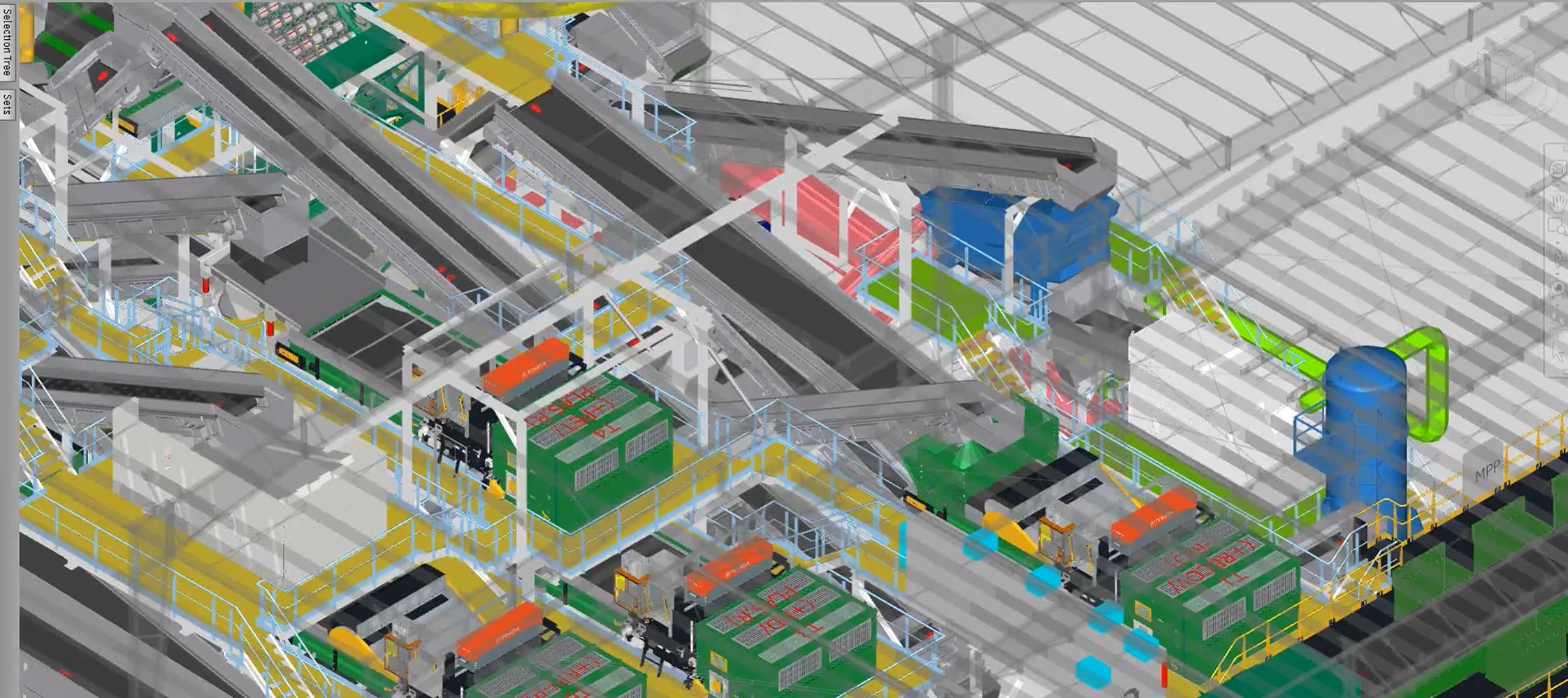
Michigan MRF: Lifecycle BIM Coordination from Concept to Commissioning
Detroit, Michigan – Scan to BIM · BIM/VDC · Equipment Coordination · Digital Twin
MEP model delivered
Trades coordinated
Field conflicts at install
A state-of-the-art materials recovery facility in Detroit required full lifecycle BIM coordination: from initial equipment layout through installation and commissioning. The project involved multiple vendors, fabricators, and field crews working in parallel across a complex facility with new sorting equipment, conveyor systems, structural platforms, and utility infrastructure. OAR served as the BIM coordination lead throughout, connecting all project stakeholders through a Common Data Environment and managing the digital thread from design through closeout.
LOD 350 Existing-Conditions and MEP Interference Modeling for a Chiller Replacement Inside an Operational School
From the field
Frequently asked questions
BIM Coordination & Virtual Construction focuses on 3D model development and clash detection for specific projects. Digital Delivery & Implementation focuses on data integration strategy, multi-platform CDE architecture, organizational capability building, and preparing data infrastructure for AI deployment. BIM Coordination solves today’s project conflicts. Digital Delivery builds the systems that make coordination better on every future project.
BIM consulting typically focuses on implementing Revit workflows and BIM Execution Plans for a single project. Digital Delivery & Implementation addresses multi-source data integration across reality capture, geotechnical, environmental, and design models, multi-platform CDE architectures, custom data integration workflows, and AI-ready data unification. It is the difference between teaching teams to use BIM software and building the data infrastructure that connects every discipline.
Timeline depends on scope. A focused engagement, CDE setup for one project or a single data integration workflow, takes 2 to 4 weeks. A comprehensive implementation program spanning an Integrated Project Twin, multi-platform CDE, multi-tier training across offices, and custom data integration workflows takes 3 to 6 months. We structure engagements to align with your project milestones.
Yes. OAR has deep expertise with Autodesk Construction Cloud, BIM 360, Revit, Civil 3D, Navisworks, and AutoCAD. We also integrate with GIS platforms (ArcGIS), geotechnical data management (BoreDM), environmental data systems, and specialized viewing environments (Cintoo). Digital Delivery & Implementation engagements often span multiple platforms.
Yes. Preparing for AI-driven design review, predictive scheduling, and automated quality analysis requires unified data architecture: consistent formats, shared coordinate systems, standardized workflows, and centralized access across all disciplines. OAR builds the data integration systems, multi-platform CDEs, and unified workflows that make AI tools usable. The organizations investing in this infrastructure today will be the ones that can actually deploy AI when those tools mature.
Yes, but not generic software training. Our training programs are tiered and discipline-specific, teaching teams how to work with integrated data environments, multi-source datasets, and unified BIM workflows. Content is tailored to your project types, discipline structure, and actual workflows.
Engineering Firms: extending capability without adding headcount. We give your team the data integration systems, CDE architecture, and training to deliver more complex programs without hiring a full VDC department.
Owners & Project Teams: building digital delivery capability that outlasts any single project. We establish the frameworks, standards, and data architecture that make every future project faster, cleaner, and more coordinated.
General Contractors: standing up a VDC program without building one from scratch. We design the systems, configure the platforms, and train your team so you can run coordinated digital delivery on every project going forward.
Engagements are structured as fixed-fee projects or monthly retainers depending on scope and duration. Send us a message with your project details and we will put together a tailored proposal.
Service areas
Digital Delivery & Implementation is delivered remotely. No geographic constraints.
Digital Delivery & Implementation
Remote consulting, training, and data integration across the US
Implementation, training, and CDE configuration are fully remote. Onboarding is fast. Most engagements start within a week of scope alignment. We have supported programs across the US with no in-person requirement.
Need field scanning to feed your new digital workflows? Our 3D Laser Scanning service is regional, based in Portsmouth, New Hampshire and serving the Northeast. Let’s talk about how the two services connect.