
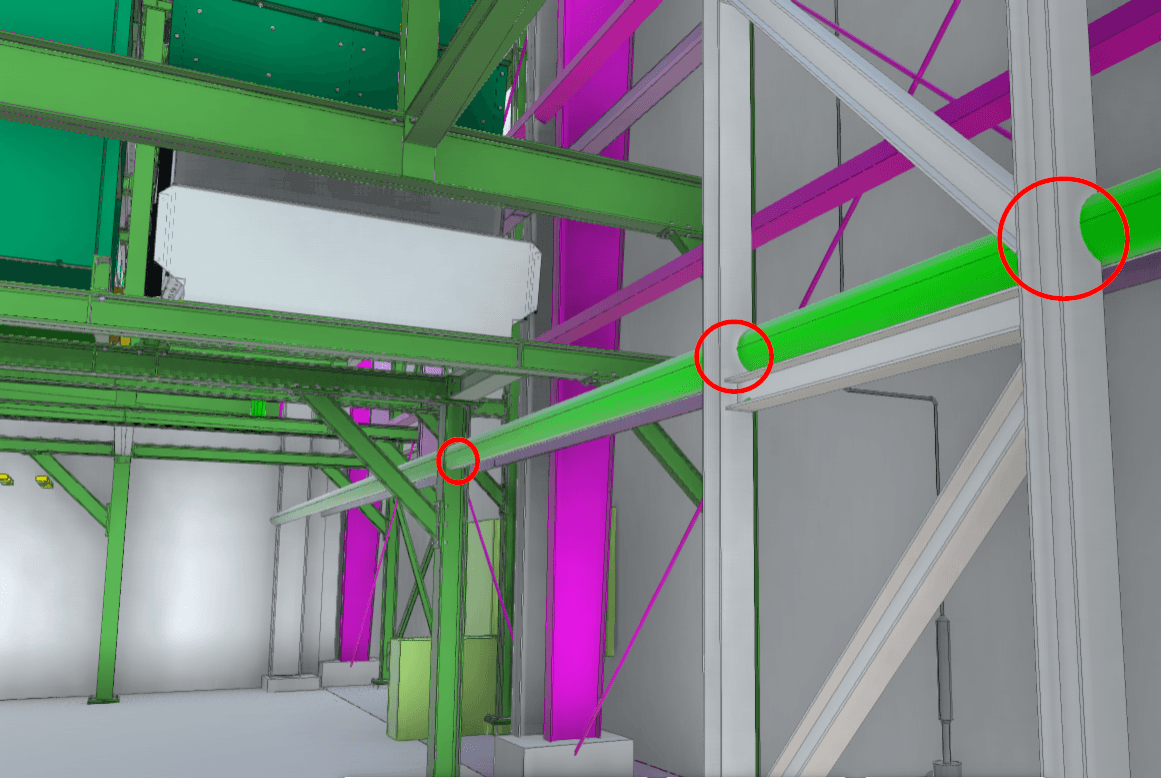

BIM clash detection finds conflicts between building systems in a federated model before construction begins. Structural elements, MEP systems, and architectural components are checked against each other, and the software reports every point where two systems occupy space they cannot both use.
That process works only as well as the model it runs on. A clash report generated from a model built on outdated drawings will miss real conflicts and flag conflicts that do not exist. Coordination teams treat the report as ground truth, but the report is only as accurate as the geometry it was built from.
This post looks at where clash detection actually fails, even when teams run it correctly, and what changes when the model reflects measured conditions instead of assumed ones.
Table of Contents
What Clash Detection Catches, and What It Depends On
A clash detection process brings design models from every discipline into one federated environment. Structural is checked against mechanical, electrical, and plumbing. Fire protection is checked against the trades competing for the same overhead space. The software flags every point of geometric overlap and produces a report for the coordination team to work through.
The report is generated from the models submitted to it. If the structural model reflects a beam location that has not existed in the field for ten years, the clash report will check every other system against a beam that is not there. Conflicts that involve the real beam location will not appear. Conflicts based on the outdated beam location will appear and consume review time on a problem that does not exist.
This is not a flaw in clash detection software. It is a description of what the software does: it checks the models it is given against each other. It does not check those models against the physical building.
Where the Highest-Risk Clashes Cluster
The clashes most likely to reach the field despite a clean coordination process cluster at the interfaces between new work and existing conditions. New MEP routing has to pass through, around, or adjacent to structure, utilities, and equipment that were installed years or decades earlier and may not appear accurately in any current drawing set.
On new construction, design models are built from the same source and tend to agree with each other on baseline geometry. On retrofit, renovation, and tenant improvement work, the new design model is coordinated against an existing conditions model that is often built from record drawings rather than measured data. If those drawings have drifted from the building, every clash check involving existing conditions inherits that error.
Why This Matters More as Clash Detection Tools Get Smarter
Reporting on BIM coordination in 2026 describes clash detection tools that are moving beyond flagging raw geometric overlaps, toward prioritizing conflicts by system importance, spatial density, and construction sequencing. These tools reduce the volume of conflicts a coordination team has to review manually, surfacing the highest-risk items first.
That shift changes what the input model is responsible for. A prioritization system built on accurate geometry surfaces the conflicts that matter most in the real building. A prioritization system built on outdated existing conditions surfaces the conflicts that matter most in a building that no longer exists. The tool performs correctly in both cases. The output is only useful in the first one.
What Changes With Scan-Based Coordination
When existing conditions are captured through laser scanning rather than pulled from record drawings, the existing conditions model reflects the geometry that is actually in the building at the time of the scan. Clash checks between new work and existing structure, utilities, or equipment run against that measured geometry instead of an estimate.
This does not eliminate clashes. Retrofit and renovation projects still generate conflicts, because new systems still have to route through space occupied by decades of prior work. What changes is which conflicts show up in the report. A clash flagged against scanned existing conditions is a clash that reflects the building. A clash cleared against scanned existing conditions is a clash the team can treat as resolved with a documented basis for that conclusion.
What This Looks Like in RFI Volume
Coordination models built on unverified existing conditions tend to generate two related problems in the field: RFIs asking whether a flagged conflict is real, and conflicts that were never flagged because the existing conditions data did not capture them. Both consume time, and both are traceable back to the accuracy of the existing conditions model rather than to the clash detection process itself.
When the coordination team can point to a scan-based existing conditions model as the basis for a clash resolution, RFIs asking whether the coordination is accurate have a documented answer built into the model. The RFI volume that remains tends to concern design decisions rather than disputes over what is actually in the building.
Where the Model Comes From Matters as Much as the Software Running On It
BIM clash detection software has become significantly more capable at organizing, prioritizing, and surfacing conflicts. That capability does not change where the underlying geometry comes from. A coordination process is only as reliable as the existing conditions model feeding it, and on retrofit, renovation, and tenant improvement work, that model is either built from record drawings that may not reflect the current building, or from measured conditions that do.
Teams evaluating a retrofit, renovation, or complex coordination effort and wanting to understand what a scan-based existing conditions model would change in their clash detection process can discuss the scope directly. Schedule a Conversation.
FAQs
What is BIM clash detection?
BIM clash detection is the process of checking federated building models from different disciplines against each other to identify where systems occupy the same physical space. Structural, mechanical, electrical, plumbing, and architectural models are compared, and the software reports every point of geometric overlap for the coordination team to review before construction begins.
Why does clash detection sometimes miss real conflicts in the field?
Clash detection checks the models it is given against each other, not against the physical building. If a model, most often the existing conditions model on a retrofit or renovation project, is built from outdated record drawings rather than measured geometry, the clash report will reflect that inaccuracy. It will miss conflicts involving the real geometry and can flag conflicts that do not exist.
Where do the highest-risk clashes tend to occur on a project?
The highest-risk clashes cluster at interfaces where new work meets existing structure, utilities, or equipment. On new construction, design models are typically built from a consistent source. On retrofit and renovation work, the existing conditions model is often the weakest link, since it may be based on drawings that have not been updated to reflect years of undocumented changes.
How does scan-based coordination change clash detection outcomes?
When existing conditions are captured through laser scanning, the existing conditions model reflects measured geometry rather than an estimate from record drawings. Clash checks between new work and existing conditions run against that measured data, so a flagged conflict is more likely to reflect an actual condition in the building, and a cleared conflict has a documented basis.
Does AI-driven clash detection reduce the need for accurate existing conditions data?
No. AI-driven clash detection tools prioritize and organize conflicts more effectively, surfacing the highest-risk items based on system importance and spatial density. That prioritization is still built on the geometry submitted to it. A model built on outdated existing conditions will be prioritized just as confidently as a model built on measured conditions, so the accuracy of the input model remains the determining factor in whether the output is useful.